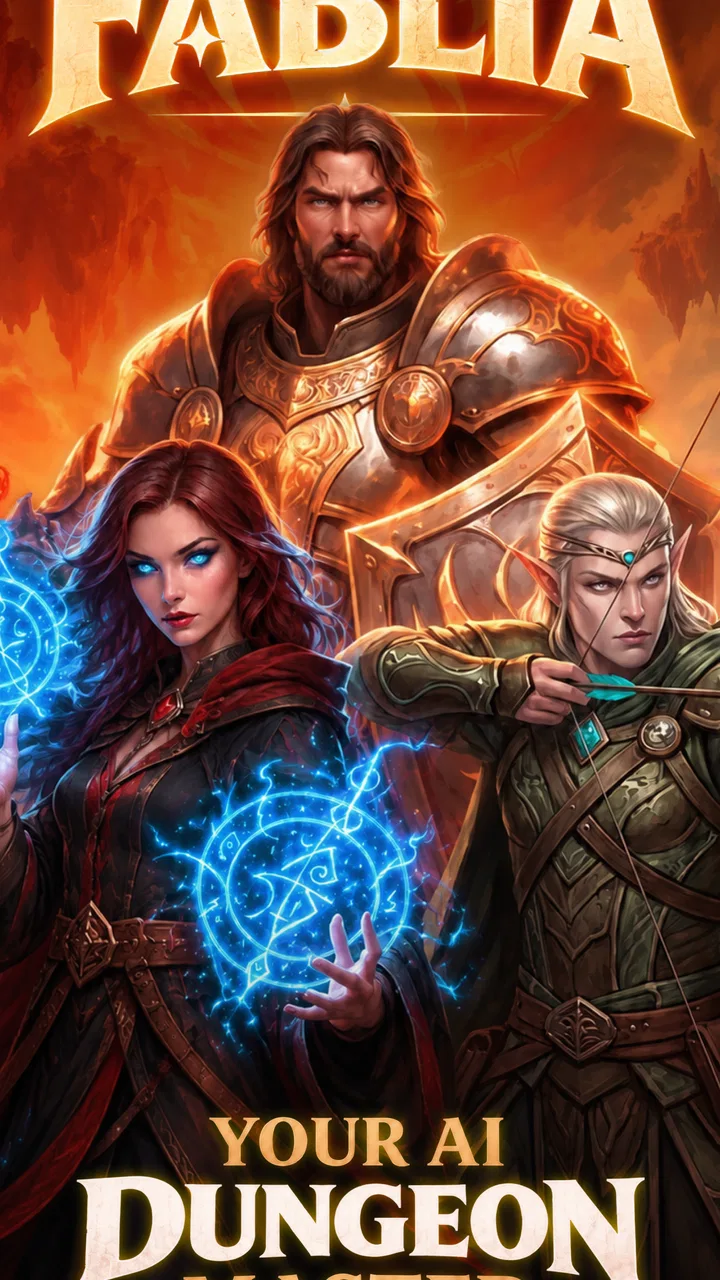
AI Dungeon Master & RPG Fablia
- 4.5
- Rating
- 10.00K
- Installs
- Free
- Price

 Analysis by App-foxy
I approached AI Dungeon Master & RPG Fablia expecting a role-playing game built around conversation rather than a fixed sequence of missions. That is the right way to think about it. Developed by Applogy Studio, this free Android game places an AI game master at the center of a fantasy adventure, while I decide what kind of hero I want to play and what action to attempt next. Instead of following one predetermined route, I can shape the story through my choices and dice rolls.
That idea makes the game immediately appealing to anyone who enjoys tabletop fantasy but does not have a group ready to play. It also creates a different kind of responsibility: the quality of my experience depends partly on how clearly I describe my character, goals, and actions. I cannot simply tap through a polished campaign and expect every moment to feel equally dramatic. The best results come when I treat the app as a responsive storytelling partner.
What the first adventure feels like
The game sits comfortably in the role-playing category, but it does not feel like a conventional mobile RPG with a long list of buttons, automatic battles, and carefully staged cutscenes. Its central attraction is the fantasy story itself. I build a hero, make decisions, and let the game master respond. The appeal is less about collecting a perfect team and more about seeing how a situation changes when I take an unexpected approach.
You May Also Like

 AccuWeather: Weather Radar
AccuWeather Review: A Quick, Clear Forecast for Everyday Decisions
For everyday plans, the best forecast is the one you can understand quickly. AccuWeather makes rain timing, radar, and local conditions easy to act on, with a few trade-offs.

 Hill Climb Racing
Why Hill Climb Racing Still Turns Crashes Into One More Run
A tiny car, a bumpy hill and one more upgrade: Hill Climb Racing keeps resurfacing because its simple chaos makes every near-miss feel personal.

 AliExpress - Shopping App
AliExpress Makes Global Shopping Feel Personal, but Shoppers Bear the Risk
AliExpress turns a global marketplace into a pocket-sized discovery engine. Its reach is useful, its shopping loop compelling, and its trade-offs easy to miss.

 Lords Mobile: Kingdom Wars
Lords Mobile Is a Kingdom-Building Routine, Not a Quick Match
A case-by-case verdict on the building, battles, device demands, and social commitments that make Lords Mobile rewarding for some players and exhausting for others.

 PDF Scanner app - TapScanner
TapScanner Makes Paperwork Easier to Capture, Check, and Share
TapScanner makes scanning with a phone feel less like a rescue operation and more like a dependable step in getting work done. Its capture tools are useful, though not flawless.

 Block Blast!
 Shows How Much a Puzzle Game Can Leave Out
A quiet grid game shows why puzzle players increasingly value instant clarity, repeatable skill and low-pressure play—and where the genre still needs to catch up.
More From Our News Desk
View All News


For a first-time player, that freedom can be exciting and slightly intimidating. A traditional RPG usually tells me where to go next through quest markers, dialogue choices, or mission objectives. Here, I need to contribute more imagination. If I write a vague action, I may receive a less satisfying continuation. If I give the hero a clear motivation and describe a practical plan, the adventure has more direction.
I found it useful to begin with a simple character concept rather than trying to invent an elaborate biography. A cautious village guard searching for a missing sibling is enough to create a purpose. A wandering mage who owes money to the wrong people gives the story an immediate source of trouble. The important part is choosing a reason to act, because it helps me decide what to do when the game presents an open situation.
The fantasy setting is also easier to enjoy when I accept that this is an improvisational experience. It is not trying to reproduce every detail of a tabletop rulebook on a phone. The pleasure comes from testing ideas: negotiating with a suspicious stranger, examining a locked door, protecting a companion, or taking a risk that a more cautious hero would avoid. The strongest moments happen when I make a specific decision instead of waiting for the game to suggest one.
That makes it a good fit for short creative sessions. I can play when I have a little time and continue a personal story without needing other players to be online. At the same time, the open-ended format means it may not satisfy someone who wants tightly balanced combat, highly detailed character statistics, or a cinematic campaign with a guaranteed dramatic arc.
Setting up a hero without overthinking it
My advice is to treat the first character as a test run. Choose a recognizable fantasy role, give the hero one strength and one weakness, and start playing. A brave fighter who is terrible at lying is more useful than a page of complicated background because it gives me clear choices during conversations and danger.
I also recommend deciding on a tone before beginning. If I want a serious quest, I should describe the hero and actions in a serious way. If I prefer a lighter adventure, I can make the character more reckless or humorous. The game becomes confusing when I expect a grim epic but give every action a joke, or when I want a relaxed story but create a hero with an impossibly heavy burden.
This is one of the first trade-offs in an AI-led RPG. The system can react to unusual ideas, but it cannot read my mind. I need to state what the character wants, what the character notices, and what result I am attempting. That small amount of preparation makes the opening feel much more intentional.
The game is free to install, with optional in-app purchases ranging from a few dollars to nearly a thousand dollars per item. I would therefore approach spending carefully and decide first whether the basic storytelling loop suits me. A free entry point is helpful for testing the concept, but players should still pay attention before confirming any optional purchase.
How to reach the first meaningful success
The first satisfying success does not have to be defeating an enemy. In my experience, it is better to set a modest objective that can be understood immediately. For example, I might ask my hero to discover who has been leaving strange marks near a village gate, then decide to question a guard rather than rush into the forest. That creates a clear action, a reason for the action, and an obvious way to judge the result.
When the game asks me to roll the dice, I see the roll as part of the story rather than a guarantee that my plan will work. A poor result can still move the adventure forward if I respond creatively. Perhaps the guard refuses to talk, but notices the hero’s unusual weapon. Perhaps the failed attempt attracts attention and creates a new problem. Instead of restarting every time something goes wrong, I get more value by treating failure as a new branch.
A useful workflow is to keep each turn focused on one intention. I first describe what I want to accomplish, then mention the method, and finally add any relevant detail. “I search the abandoned shrine for signs of recent visitors, avoiding the unstable floor” is more actionable than “I investigate.” This habit reduces confusion and gives the AI game master something concrete to build on.
Another helpful technique is to ask for a small amount of clarification when the scene becomes unclear. I can state that I want to inspect the surroundings before committing to a fight, or explain that my character is trying to persuade rather than threaten. This keeps the story aligned with my intention without turning every turn into a long explanation.
For a first session, I would aim for a short chain of decisions: establish the hero, investigate one problem, make one risky choice, and see the consequence. That is enough to understand whether the format works for me. I do not need to create a huge world or plan a multi-part saga immediately.
Where new players may become confused
The biggest adjustment is understanding that the game is not a normal menu-driven adventure. I may be tempted to search for the single correct command, but the experience is better when I describe an intention in natural language. There can be several reasonable ways to approach a situation, and the fun comes from choosing one rather than hunting for a hidden solution.
It is also easy to make a hero who is too powerful. If my character can solve every problem with magic, wealth, perfect combat ability, and unlimited knowledge, the story loses tension. Giving the hero a real limitation creates useful decisions. A skilled archer who cannot read ancient writing has a reason to seek help. A persuasive noble who is physically fragile must think before entering danger.
Another source of friction is continuity. In an open-ended story, I need to remember important names, promises, injuries, and clues. I found it practical to keep a short note outside the game after an important scene. I would record the hero’s goal, the current threat, and any unresolved lead. This is not glamorous, but it prevents the adventure from becoming a collection of disconnected moments.
I would also avoid packing too many actions into one message. If I try to sneak past a guard, search a building, question a prisoner, and leave before anyone notices, the result may feel less precise than if I handle those steps separately. Breaking a complicated plan into stages gives me more control and makes the dice-based consequences easier to understand.
The AI approach has another limitation: it can be imaginative, but it may not always deliver the exact pacing I want. One scene may feel wonderfully responsive while another feels less focused. When that happens, I can steer the tone by stating what matters now: a tense negotiation, a quick action scene, or a careful investigation. I should not expect every response to resemble a professionally edited novel.
Making the second session more satisfying
Once I understand the basic loop, I would give the hero a goal that can survive several scenes. “Find the lost sword” is serviceable, but “find the lost sword before the former owner’s family is blamed for its disappearance” gives me a moral and practical reason to keep going. A goal with pressure attached creates better opportunities for difficult choices.
I would also introduce one recurring relationship. It could be a suspicious guide, a rival treasure hunter, or a nervous witness. The point is not to invent a large cast immediately. One memorable relationship gives the story continuity and lets me decide whether the hero trusts, deceives, protects, or abandons someone.
A strong advanced habit is to separate information from interpretation. If my hero sees muddy footprints, I should not automatically declare that an enemy passed through. I can describe the evidence and ask what can be learned from it. This leaves room for discovery and reduces the chance that I accidentally force the story toward an unsupported conclusion.
Another trade-off involves speed. Short actions are easier to manage during a quick break, while longer descriptions can create richer scenes when I have time to play. I would use concise commands during travel or routine investigation, then slow down for choices that define the character. This makes the game work better as both a brief mobile pastime and a longer evening session.
Version 2.6.6 is the current version, and the game requires Android 7.0 or later. That makes the technical entry point reasonably approachable for people using older compatible Android devices, although the actual comfort of play will still depend on the phone’s screen, keyboard, and general performance. Since the experience relies heavily on reading and writing, a device that feels cramped or awkward for text entry may reduce the enjoyment.
Who should try it, and who should choose something else
I would recommend this game to someone who enjoys fantasy role-playing but wants personal control over the story. It is especially suitable for a solo player who likes experimenting with unusual plans, writing character actions, and accepting unexpected consequences. It can also be a useful way to practice improvisational storytelling because it rewards clear goals and flexible thinking.
It is less suitable for anyone looking primarily for fast visual action. If my ideal mobile RPG is built around real-time combat, elaborate animations, equipment optimization, or competitive progression, a conventional action or strategy game will probably be a better match. This experience asks me to read, imagine, and make decisions; it does not replace the satisfaction of directly controlling a character in a visually rich battlefield.
Players who dislike uncertainty may also find the format frustrating. A fixed campaign offers reassurance that each mission has been designed and tested around a particular sequence. Here, the adventure is more open, so I need to tolerate uneven pacing and occasional results that are not exactly what I pictured. The benefit is freedom; the cost is less predictability.
The age rating is Everyone, which makes the game broadly accessible from a content-rating perspective. Even so, I would still consider the preferences of the person playing, especially because fantasy stories can vary in mood depending on the choices and situations created during play. The rating is not a promise that every personal adventure will feel equally gentle or light.
The game has an average rating of 4.5 from over 500 ratings, and it has passed 10 thousand installs. Those figures suggest that the concept has found an interested audience, but I would not use them as a substitute for trying the actual interaction style. A strong rating cannot tell me whether I personally enjoy writing actions and guiding an AI-led story.
My recommendation after using the full loop
What I like most is the way a small decision can become the center of a fantasy scene. I am not limited to selecting from four prepared responses, so I can play a cautious hero, a manipulative negotiator, or an impulsive adventurer without changing to a completely different game mode. That flexibility gives the experience a personal quality that many standard mobile RPGs do not provide.
The main weakness is equally clear: the game needs active participation. It is not something I can enjoy fully while barely paying attention. I have to read the situation, decide what matters, and communicate the next move. If I am tired and want a simple reward loop, the open-ended structure may feel like work rather than relaxation.
My practical recommendation is to begin with a small, clearly defined quest and keep notes once the story develops. Give the hero a limitation, describe one action at a time, and treat failed rolls as complications instead of dead ends. Those habits make the first meaningful success arrive sooner and help the adventure feel coherent.
For me, AI Dungeon Master & RPG Fablia is most successful as a pocket storytelling table: not a replacement for every traditional RPG, but a convenient solo option when I want to create a fantasy situation and decide how my character responds. Applogy Studio has chosen an appealing format for imaginative players, and the free starting point makes it easy to test. I would recommend it to readers who want agency and surprise, while advising action-focused players to look elsewhere. If you enjoy shaping the story more than following a preset path, this is worth trying.
FAQs for AI Dungeon Master & RPG Fablia
01What is AI Dungeon Master & RPG Fablia?
AI Dungeon Master & RPG Fablia is an interactive role-playing game that uses artificial intelligence to create adventures, narrate events, and respond to your decisions. Instead of following one fixed storyline, you can explore a fantasy world, speak with characters, accept quests, and shape the direction of the story through your choices. Each session is designed to feel personal and unpredictable.
02Do I need previous RPG experience to play Fablia?
No previous role-playing experience is required. Fablia is designed to be accessible to beginners while still offering enough freedom for experienced RPG fans. The AI Dungeon Master guides the adventure, explains situations, and reacts to natural-language commands. You can play at your own pace, experiment with different decisions, and learn the game’s systems without studying complicated rules first.
03Does AI Dungeon Master & RPG Fablia require an internet connection?
An internet connection may be necessary for the main gameplay experience because Fablia relies on AI-powered storytelling and remote services to generate responses. Without a stable connection, narration, character interactions, or adventure progression may be interrupted. Before downloading, check the current store description and the developer’s requirements, especially if you plan to play while traveling or using mobile data.
04Is AI Dungeon Master & RPG Fablia free to download?
The app may be available to download without an upfront purchase, but some features can depend on advertising, in-app purchases, subscriptions, or usage limits. Availability and pricing can vary between Android and iOS and may also change after updates. Review the store listing carefully before starting, particularly if several people use the same device or payment account.
05Is Fablia suitable for children and does it include mature content?
Because Fablia generates stories dynamically, the content can vary depending on the adventure, prompts, and interactions selected by the player. Some scenarios may include fantasy violence, frightening themes, romance, or other mature elements. Parents should check the official age rating, privacy information, and available safety controls before allowing children to use the app, and supervise younger players when necessary.
Pros
- AI-generated stories adapt quickly to your choices.
- Supports creative role-playing without needing a fixed party.
- Offers varied fantasy scenarios for different play styles.
- Text-based format works well on most modern devices.
- Useful for solo players seeking spontaneous adventure ideas.
Cons
- Story quality can vary noticeably between different sessions.
- AI responses may occasionally contradict earlier events.
- Long adventures can lose focus or narrative consistency.
- Some features or content may require in-app purchases.
- Requires an internet connection for most AI-generated interactions.

AI Dungeon Master & RPG Fablia
Gallery